Skip to the content
Skip to content
Skip to the content
Skip to content Home / Blog
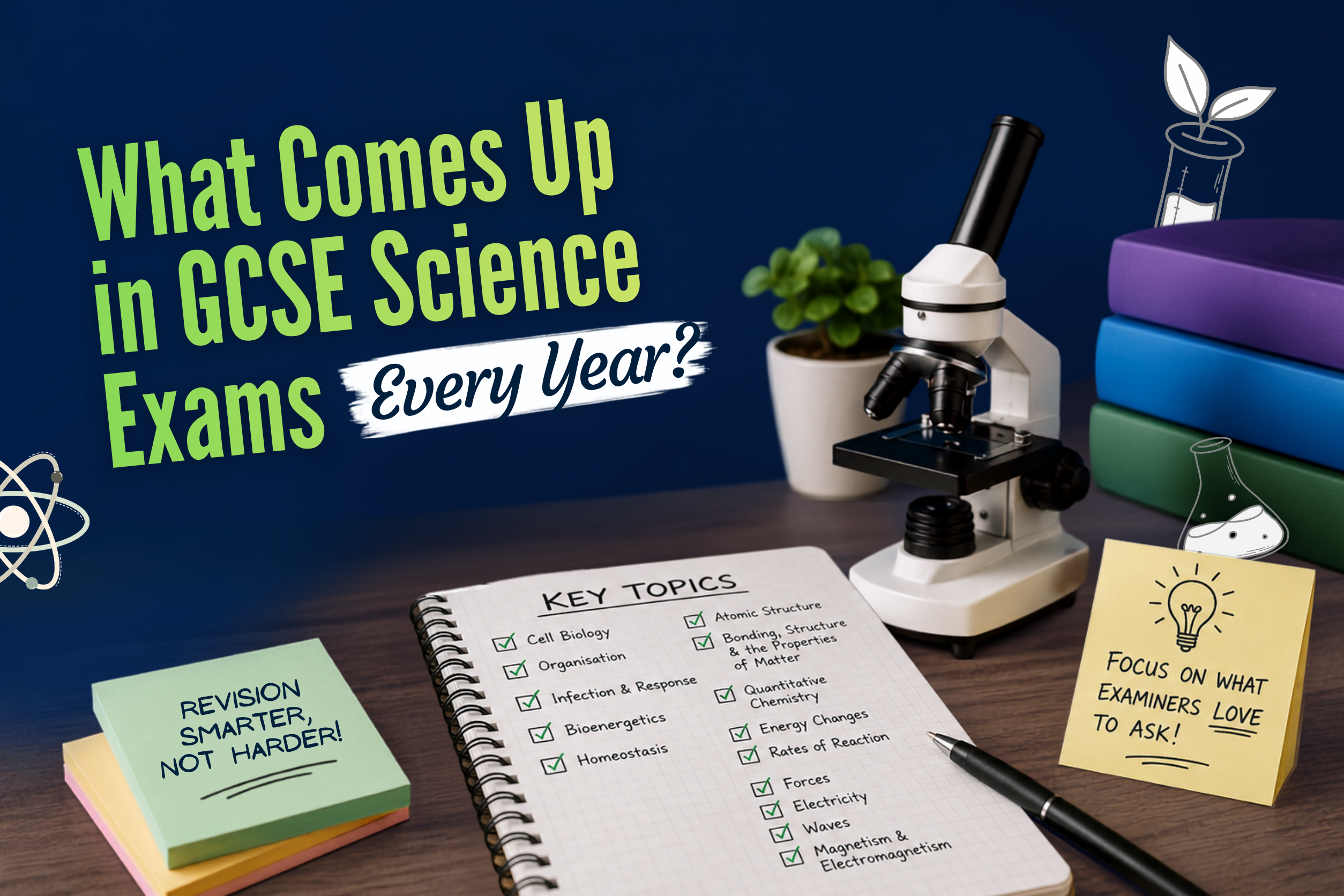
Answer first: Every year, GCSE Science exams test the same fixed set of specification topics across Biology, Chemistry and Physics — there are no surprise subjects. Knowing exactly what comes up in GCSE Science exams every year lets you focus your revision on the high-frequency content, required practicals and maths skills that examiners repeat in almost every series.
If you have ever opened a stack of GCSE Science past papers and felt the questions look strangely familiar, you are right. After helping students prepare across several exam seasons, the clearest pattern we see is this: the wording changes, but the underlying GCSE Science exam topics stay remarkably consistent year after year.
GCSE Science is built around a published specification, not a random question bank. Exam boards such as AQA, Edexcel and OCR must test the entire specification over time, which is why core ideas like photosynthesis, the periodic table and forces resurface in series after series.
This predictability is the single biggest advantage in GCSE Science revision. Once you map the specification, you stop guessing and start targeting the GCSE Science important topics that carry the most marks.
Biology is split across two papers. The GCSE Biology exam topics are fixed by the specification, so they reappear every year — only the question style changes.
Photosynthesis, enzymes and genetic crosses are among the most reliably repeated questions, making them essential anchors in any GCSE Science revision guide.
Chemistry rewards students who drill the maths-heavy content early. These GCSE Chemistry exam topics appear in some form across nearly every exam series.
Mole calculations and electrolysis are perennial mark-grabbers, so prioritise them in your GCSE Science exam preparation.
Physics blends conceptual understanding with equation work. The GCSE Physics exam topics below are tested every year, and around half the marks reward recall and correct use of formulae.
A one-page equation sheet covering work done, power, density and F = ma is one of the highest-return revision tools you can build.
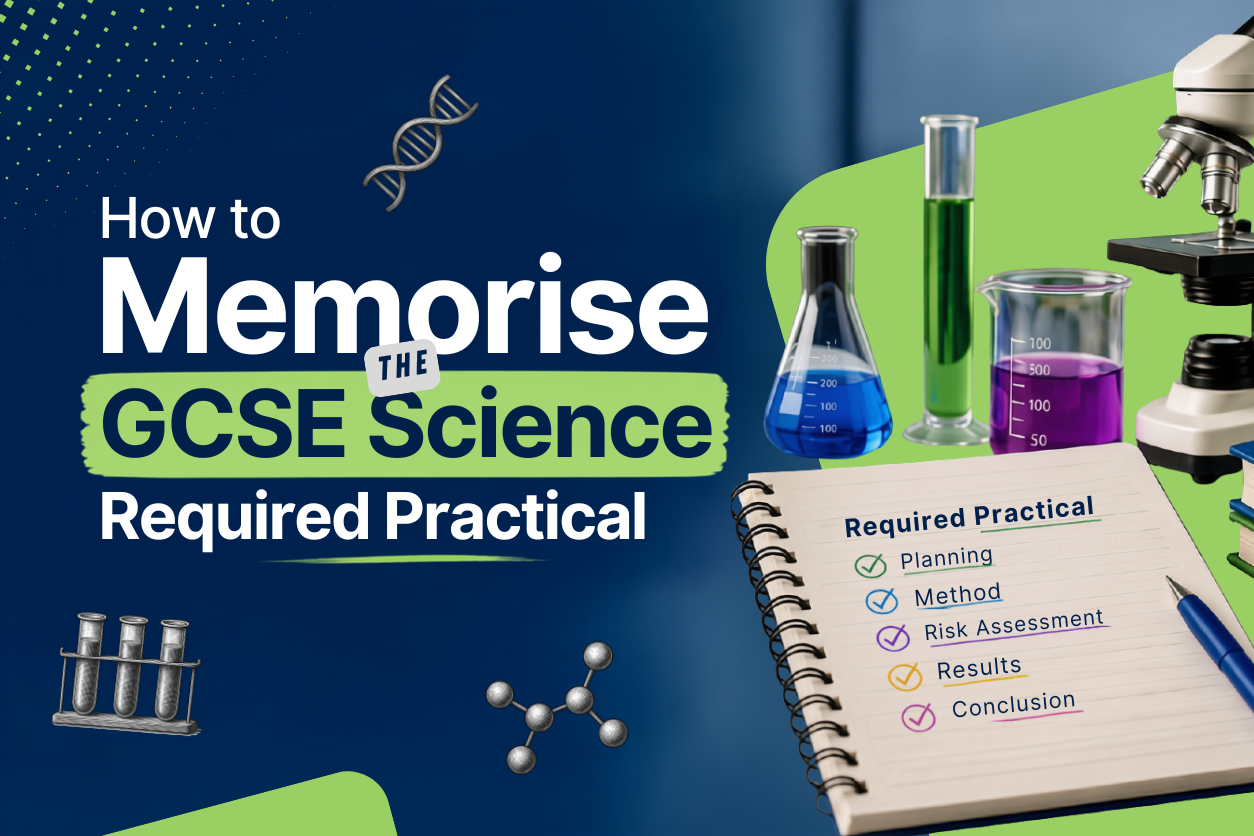
Beyond content, every year examiners test the required practicals. You will not perform experiments in the exam, but you will answer questions on the methods, variables and results.
Across Combined Science there are 21 required practicals, and practical-based questions appear in all six papers. The most common mistake is not knowing the control variables — so for every practical, be ready to state what was changed, what was measured and what was kept constant, and to explain why.
GCSE Science past papers are the closest thing to a crystal ball you will get. Working through several years of papers exposes the recurring question patterns far faster than re-reading notes.
Here is the approach that delivers the biggest score jumps:
A focused plan turns predictability into marks. Use this lightweight structure for effective GCSE Science revision in the final weeks.
This cycle is the backbone of any reliable GCSE Science revision guide, and it scales whether you are sitting Foundation or Higher tier.
Yes. The topics are fixed by the published specification, so the same Biology, Chemistry and Physics content is tested every year. Only the phrasing, context and difficulty of individual questions change.
No. Nobody outside the exam boards knows the precise questions. Predicted papers are educated guesses based on past trends and should only supplement full-specification revision — never replace it.
At least 20% of marks across GCSE Combined Science reward mathematical skills, so practising calculations is non-negotiable for a strong grade.
Focus on high-frequency, high-mark GCSE Science important topics: photosynthesis and genetics in Biology, moles and electrolysis in Chemistry, and forces and electricity in Physics.
The reassuring truth about what comes up in GCSE Science exams every year is that there are no genuine surprises — just a fixed specification dressed in slightly different questions each series. Map the topics, master the required practicals, drill the maths and rehearse with past papers.
Ready to take the guesswork out of revision? Download your exam board’s specification today, build your red-amber-green checklist, and start your first timed past paper this week.

GCSE Sciences can assist you in advancing your academic knowledge and increasing your understanding of core concepts through our practical approach based courses.
Subcribe to notifications to get news
2026 © Copyrights Gscesciences All Right Recived
Know a friend who’s tackling GCSE or A-level Biology, Chemistry or Physics? Refer them to GCSE Sciences and you’ll both get *£10 off* of tuition once they join.
WhatsApp us
 Optimized by Seraphinite Accelerator