Skip to the content
Skip to content
Skip to the content
Skip to content 
Home / Blog
Revising for GCSE Science can feel overwhelming, especially when you have a large amount of Biology, Chemistry and Physics content to remember. Simply reading your textbook or highlighting notes may feel productive, but these methods do not always help you remember information when you need it most — especially in an exam.
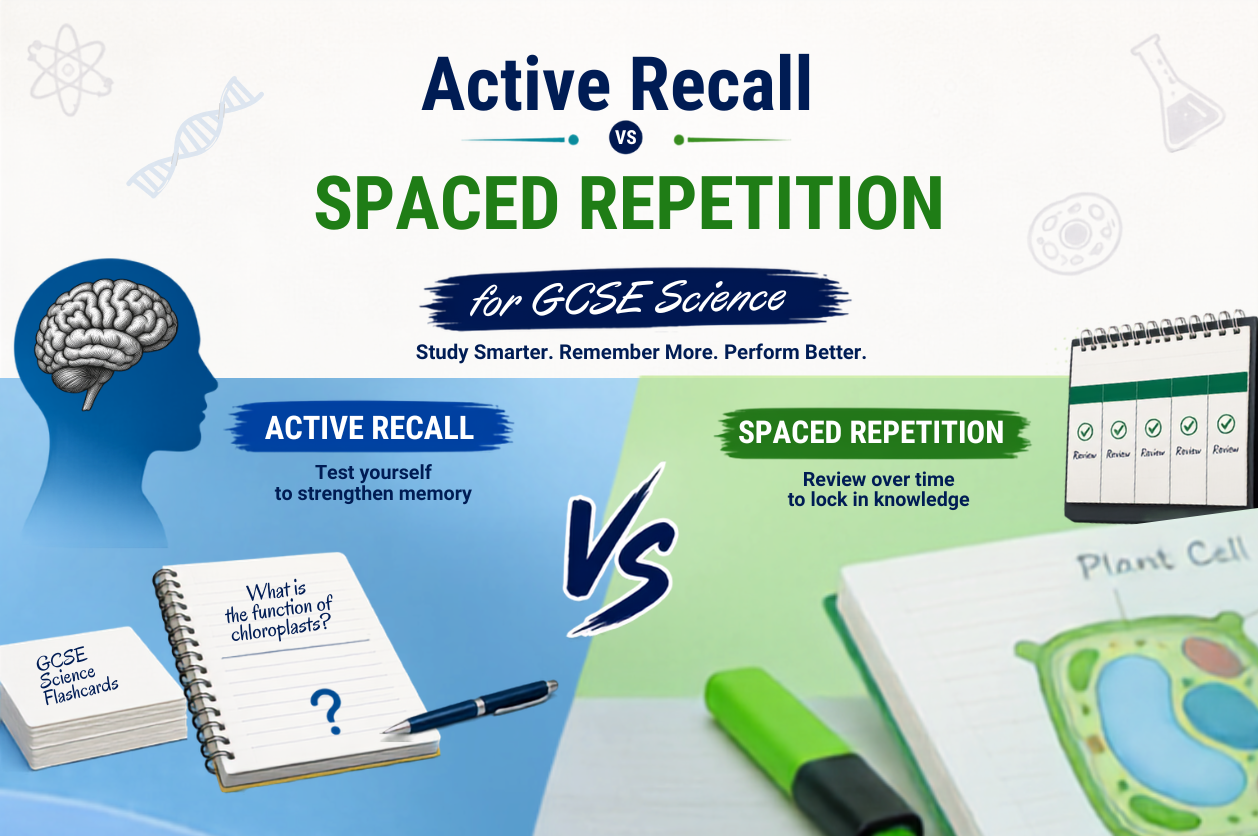
Two of the most effective GCSE science revision techniques are active recall and spaced repetition. But when it comes to active recall vs spaced repetition, which method should you use?
The good news is that you do not necessarily have to choose between them. Understanding how each technique works — and combining them correctly — can make your revision more effective.
Active recall is a revision technique where you actively try to remember information without looking at your notes or textbook.
Instead of repeatedly reading a page about photosynthesis, for example, you could close your book and ask yourself:
You then check your answers against your notes and correct anything you missed.
This makes active recall different from simply rereading your notes. You are forcing your brain to retrieve information from memory.
There are several ways to use active recall for GCSE Science, including:
Create a question on one side and the answer on the other.
For example:
Question: What is the equation for photosynthesis?
Answer: Carbon dioxide + water → glucose + oxygen.
Try to answer the question before turning the card over.
GCSE Science exam questions are an excellent form of active recall because they require you to retrieve knowledge and apply it to a particular situation.
Write down everything you can remember about a topic without looking at your notes. Afterwards, compare your answer with your revision materials.
Ask yourself questions about the topics you have studied and answer them from memory.
These methods can make active recall one of the most useful GCSE science revision methods.
Revisit each practical after one day, then one week, then before mocks and before the real exam. This spaced repetition is what moves facts from short-term to long-term memory.
Spaced repetition is a revision method where you review information at gradually increasing intervals.
Instead of studying a topic for several hours in one day, you revisit it regularly over a longer period.
For example, you might review a topic:
The exact schedule can vary depending on how well you remember the material.
The idea behind spaced repetition is to revisit information before you completely forget it. Over time, this can help strengthen your long-term memory.
You can use spaced repetition with flashcards, quizzes, notes and practice questions.
For example, imagine you have studied GCSE Chemistry – Atomic Structure.
On Monday, you learn the topic and test yourself.
On Wednesday, you review the questions you struggled with.
The following week, you test yourself again.
A few weeks later, you revisit the topic alongside other Chemistry topics.
This approach prevents you from leaving revision until the week before your GCSE exams.
Although active recall and spaced repetition are often discussed together, they are not the same thing.
You test yourself and retrieve information from memory rather than simply looking at it.
You revisit information at planned intervals rather than studying everything at once.
Think of it this way:
Active recall = retrieve the information.
Spaced repetition = revisit the information over time.
This is why combining both techniques can be particularly useful for GCSE Science.
When comparing active recall vs spaced repetition, it is difficult to say that one is universally better than the other because they solve different problems.
Active recall helps you practise retrieving information.
Spaced repetition helps you retain that information over a longer period.
For GCSE Science students, using both together can create a strong revision strategy.
For example, you could create flashcards for GCSE Biology and use active recall to answer them. You could then use spaced repetition to decide when those flashcards should be reviewed again.
This means you are not just repeatedly reading your Biology notes. You are actively testing your knowledge and revisiting it regularly.
One of the best revision techniques for GCSE Science in uk is to combine active recall with spaced repetition.
Here is a simple process you can follow.
Start by learning the basic information from your textbook, teacher, revision guide or GCSE Science resources.
Don’t worry about memorising everything immediately.
Turn important information into questions.
For example:
Biology: What is the function of the mitochondria?
Chemistry: What is the difference between an element and a compound?
Physics: What is the equation for calculating speed?
Put your notes away and answer the questions from memory.
This is active recall.
Mark your answers and identify areas where you made mistakes.
If you cannot remember something, add it to your priority revision list.
Review difficult questions more frequently than information you already know well.
Once you can consistently answer a question correctly, increase the time before you test yourself again.
This is spaced repetition.
Active recall can be applied to all three GCSE Science subjects.
Biology contains many processes, definitions and key terms that students need to remember.
Active recall can help with topics such as:
For example, rather than rereading the stages of the menstrual cycle, create questions and try to explain the process without looking at your notes.
Chemistry involves equations, definitions, reactions and scientific concepts.
You can use active recall to revise:
Flashcards can be particularly useful for remembering definitions and chemical equations.
Physics requires both knowledge and application.
Use active recall to practise:
However, remember that GCSE Physics revision should not rely entirely on memorisation. You should also practise applying equations and concepts to exam-style questions.
If you are wondering how to revise for GCSE Science, start by creating a revision routine rather than trying to study everything at once.
A simple weekly structure could look like this:
Monday: GCSE Biology active recall
Tuesday: GCSE Chemistry active recall
Wednesday: GCSE Physics active recall
Thursday: Review Biology using spaced repetition
Friday: Review Chemistry and Physics
Weekend: Mixed GCSE Science practice questions
You can adjust this depending on your subjects, timetable and exam dates.
The important thing is consistency.
Even with good revision techniques, students can make mistakes that reduce the effectiveness of their study sessions.
Reading your notes repeatedly can give you the feeling that you know the topic. However, recognising information is not the same as being able to recall it independently.
Trying to learn an entire GCSE Science course in a few days can be stressful and ineffective.
Spaced repetition encourages you to start earlier and revisit topics regularly.
Students sometimes spend too much time revising topics they already understand because it feels easier.
Instead, use active recall to identify weaknesses and spend more time on areas where you struggle.
Knowing the scientific content is important, but GCSE exams also test your ability to apply knowledge.
Include past-paper and exam-style questions in your revision routine.
So, which is better: active recall or spaced repetition?
Rather than choosing one, GCSE Science students should consider using both.
Active recall helps you determine whether you can actually retrieve information from memory, while spaced repetition helps you revisit that information over time.
Together, they can form an effective approach to GCSE Science revision.
A simple strategy is:
Learn → Test yourself → Identify weaknesses → Review → Test again → Increase the interval → Practise exam questions
This approach can be used for GCSE Biology, Chemistry and Physics.
Effective GCSE Science revision is not about spending the longest possible time studying. It is about using your study time effectively.
When comparing active recall vs spaced repetition, remember that the two techniques work in different ways. Active recall focuses on retrieving information, while spaced repetition focuses on reviewing information at intervals.
By combining both techniques with regular exam-question practice, you can build a structured approach to GCSE Science revision and improve your ability to remember and apply important concepts.
Start with one topic today, create a few questions, test yourself without your notes and schedule your next review. Small, consistent revision sessions can make a big difference as your GCSE exams approach.

GCSE Sciences can assist you in advancing your academic knowledge and increasing your understanding of core concepts through our practical approach based courses.
Subcribe to notifications to get news
2026 © Copyrights Gscesciences All Right Recived
Know a friend who’s tackling GCSE or A-level Biology, Chemistry or Physics? Refer them to GCSE Sciences and you’ll both get *£10 off* of tuition once they join.
WhatsApp us
 Optimized by Seraphinite Accelerator