Skip to the content
Skip to content
Skip to the content
Skip to content 
Home / Blog
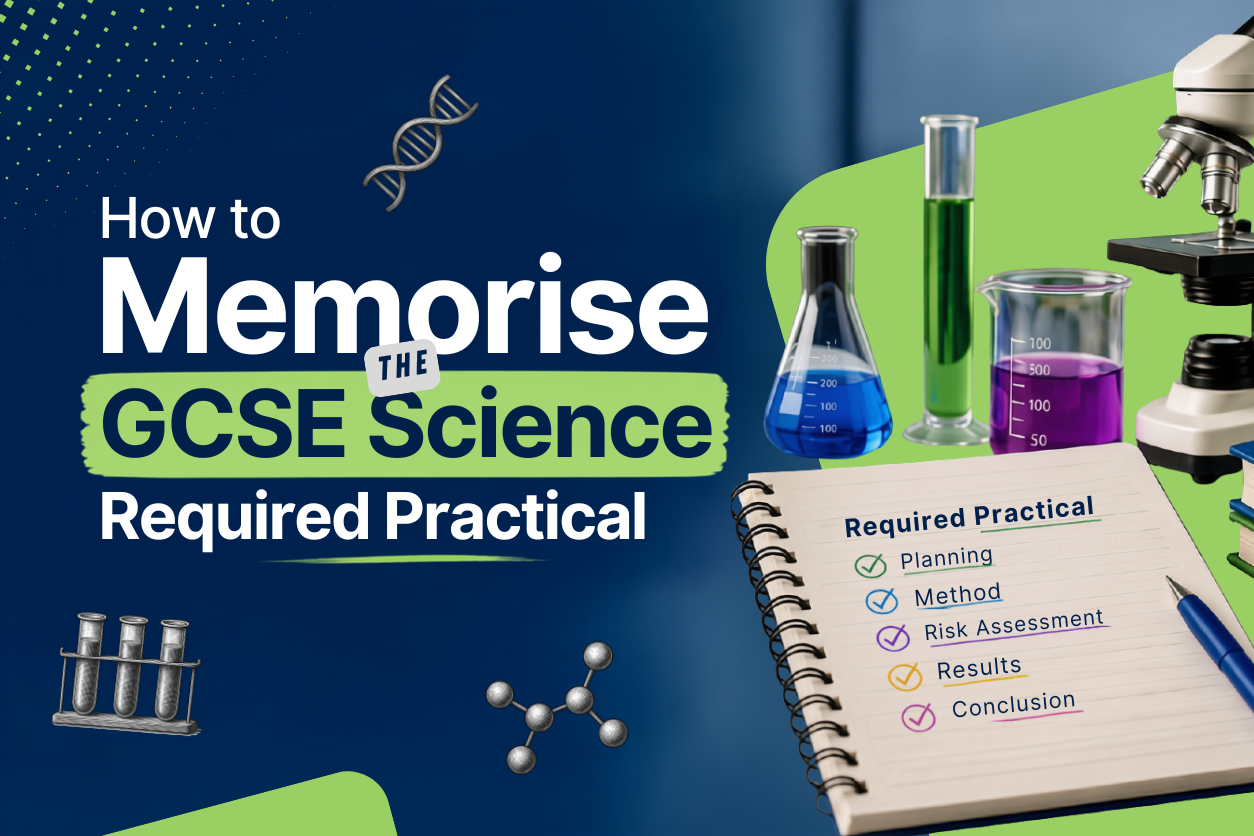
The best way to memorise GCSE Science required practicals is to combine active recall with structured repetition: learn each practical’s aim, method, variables and results using flashcards, then test yourself with past-paper questions and diagrams over several short sessions spread across weeks, rather than re-reading notes once before the exam.
Required practicals catch out even strong students because they’re tested indirectly — through unfamiliar exam questions, not by asking you to simply describe what you did in the lab. This guide gives you a clear, step-by-step system for revising every Biology, Chemistry and Physics required practical so the details actually stick.
Required practicals are the mandatory experiments built into every GCSE Science specification (AQA, Edexcel, OCR). You’ve carried them out in lessons, but the exam boards don’t just ask “what did you do?” Instead, questions test whether you understand the practical well enough to apply it to a new context — a slightly different set-up, an unusual data set, or a “suggest an improvement” prompt you’ve never seen before.
Typically, 15–20% of your total exam marks across Biology, Chemistry and Physics relate to required practicals in some way. That’s a significant, learnable chunk of your grade — but only if you revise them properly rather than assuming lab memory will carry you through.
Trying to remember 8–10 practicals per science by re-reading a textbook rarely works. Use this five-step approach instead.
For each required practical, condense your notes onto a single page covering aim, equipment, method, variables, results and safety. A one-page limit forces you to identify what actually matters.
Turn every key fact into a question-and-answer pair — “Why is a colorimeter used instead of judging colour by eye?” rather than a passive statement. This is where active recall starts doing the heavy lifting.
Apparatus diagrams (like the reflux set-up in Chemistry or the light-intensity investigation in Biology) are commonly tested. Draw the set-up blank, then check it against your notes and correct any labelling gaps.
Past papers reveal how examiners actually phrase questions — usually asking you to apply the method to a new scenario, spot an error, or interpret unfamiliar results.
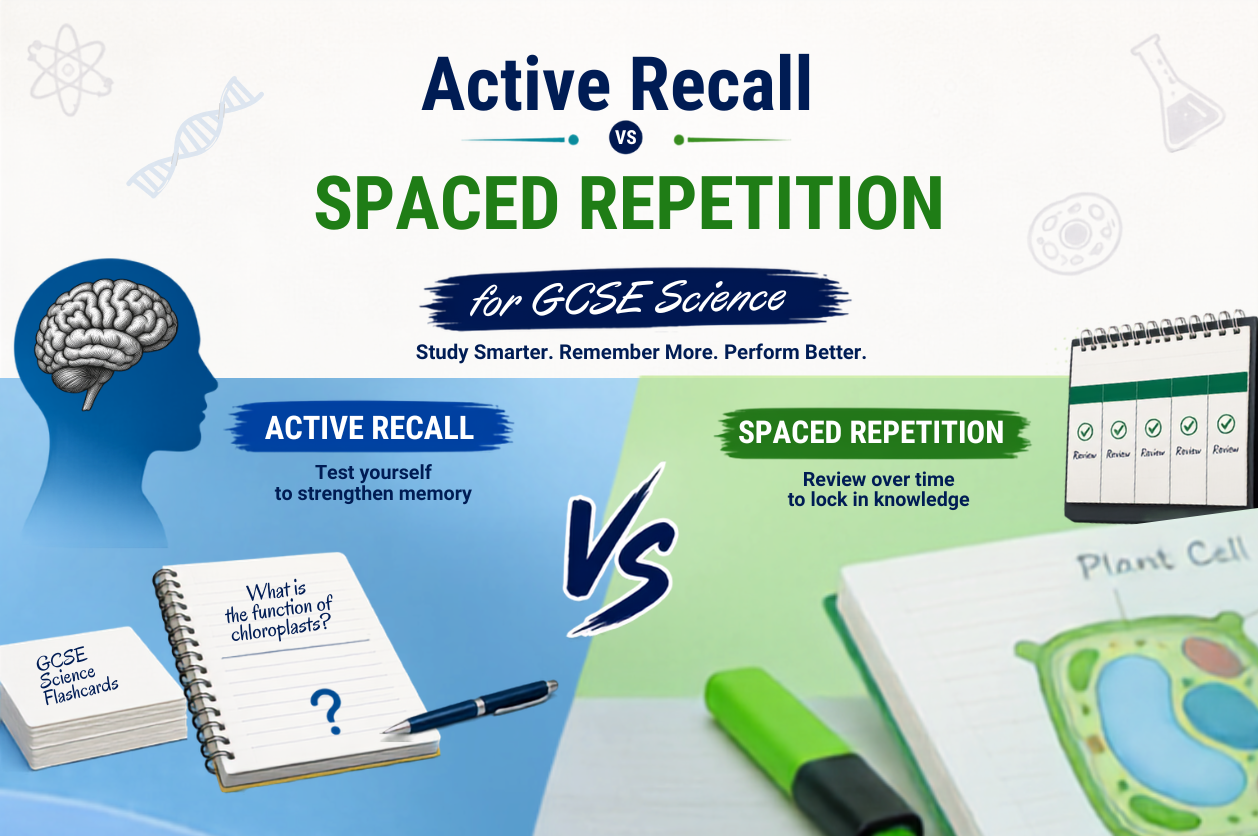
Revisit each practical after one day, then one week, then before mocks and before the real exam. This spaced repetition is what moves facts from short-term to long-term memory.
For each required practical, aim to confidently recall:
Learning these ten categories consistently, practical by practical, is the single most effective GCSE Science practical revision habit you can build.
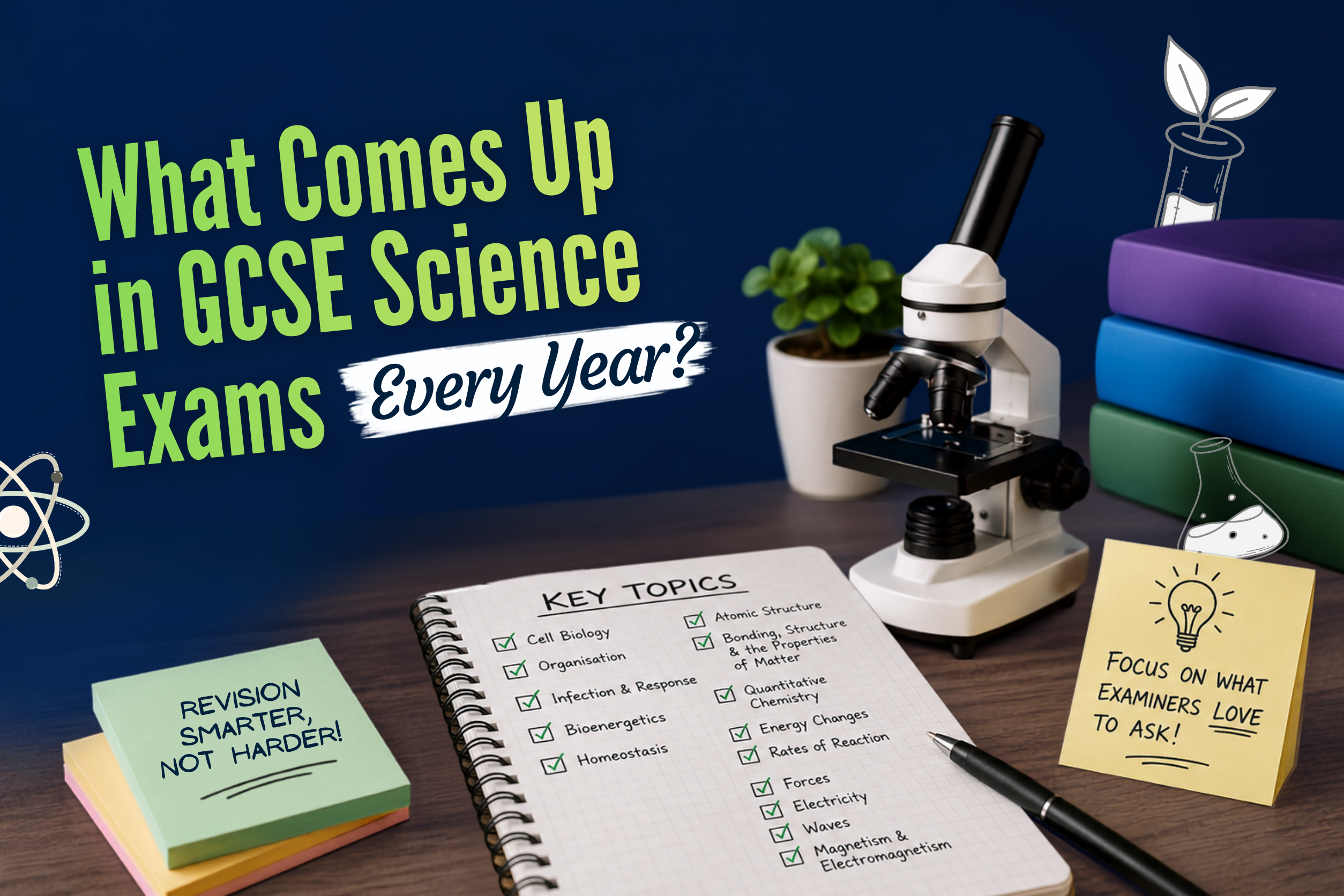
Common Biology required practicals include microscopy of cells, osmosis in potato cylinders, food tests, enzyme reaction rates, effect of light intensity on photosynthesis, and investigating reaction time. Focus your revision on independent/dependent variables (these are heavily tested) and on describing trends in graphs using data, not just words like “increases.”
Chemistry required practicals typically include making soluble salts, titration, electrolysis, temperature changes in reactions, chromatography, and rates of reaction. Prioritise apparatus diagrams and safety precautions here, since Chemistry questions frequently ask you to identify equipment or explain why a specific piece of kit (like a burette rather than a measuring cylinder) improves accuracy.
Physics required practicals often cover density, resistance in circuits, waves, radiation and absorption, force and extension (Hooke’s Law), and specific heat capacity. Physics questions lean heavily on calculations and graphs, so make sure you can rearrange formulas and describe what a graph’s gradient or intercept represents.
“Explain why the student repeated the experiment three times.” — Answer in terms of reliability and identifying anomalies, not just “to be accurate.”
“Suggest one improvement to increase the accuracy of the results.” — Link your answer to a specific measurement issue in that practical (e.g. using a data logger instead of a stopwatch for faster reactions).
“Describe the trend shown in the graph.” — Always reference actual values from the graph, not just “it goes up.”
Tip: Examiners reward answers that clearly connect to the specific practical context, not generic statements that could apply to any experiment.
This depends on your exam board and whether you're studying Combined or Triple Science, but most specifications include around 8 required practicals per science (Biology, Chemistry, Physics), meaning up to 24 in Triple Science.
Exam boards generally allocate around 15% of marks to required practical content, though this varies slightly by board and subject.
Use your class notes, textbook diagrams and exam board practical guides to rebuild your understanding from scratch, then follow the same flashcard and active recall process.
Break the method into a numbered sequence, turn each step into a flashcard question, and practise writing it out from memory rather than copying it.
The core practicals are similar, but exact wording, equipment and expectations vary by board, so always check your specific specification document.
Ideally, begin building summary sheets and flashcards as each practical is taught in class, then use spaced repetition in the months leading up to exams rather than starting from scratch during study leave.
Follow this system consistently and required practical questions will stop feeling unpredictable — they’ll become one of the most reliable places to pick up marks on your GCSE Science papers.

GCSE Sciences can assist you in advancing your academic knowledge and increasing your understanding of core concepts through our practical approach based courses.
Subcribe to notifications to get news
2026 © Copyrights Gscesciences All Right Recived
Know a friend who’s tackling GCSE or A-level Biology, Chemistry or Physics? Refer them to GCSE Sciences and you’ll both get *£10 off* of tuition once they join.
WhatsApp us
 Optimized by Seraphinite Accelerator