Home / Blog
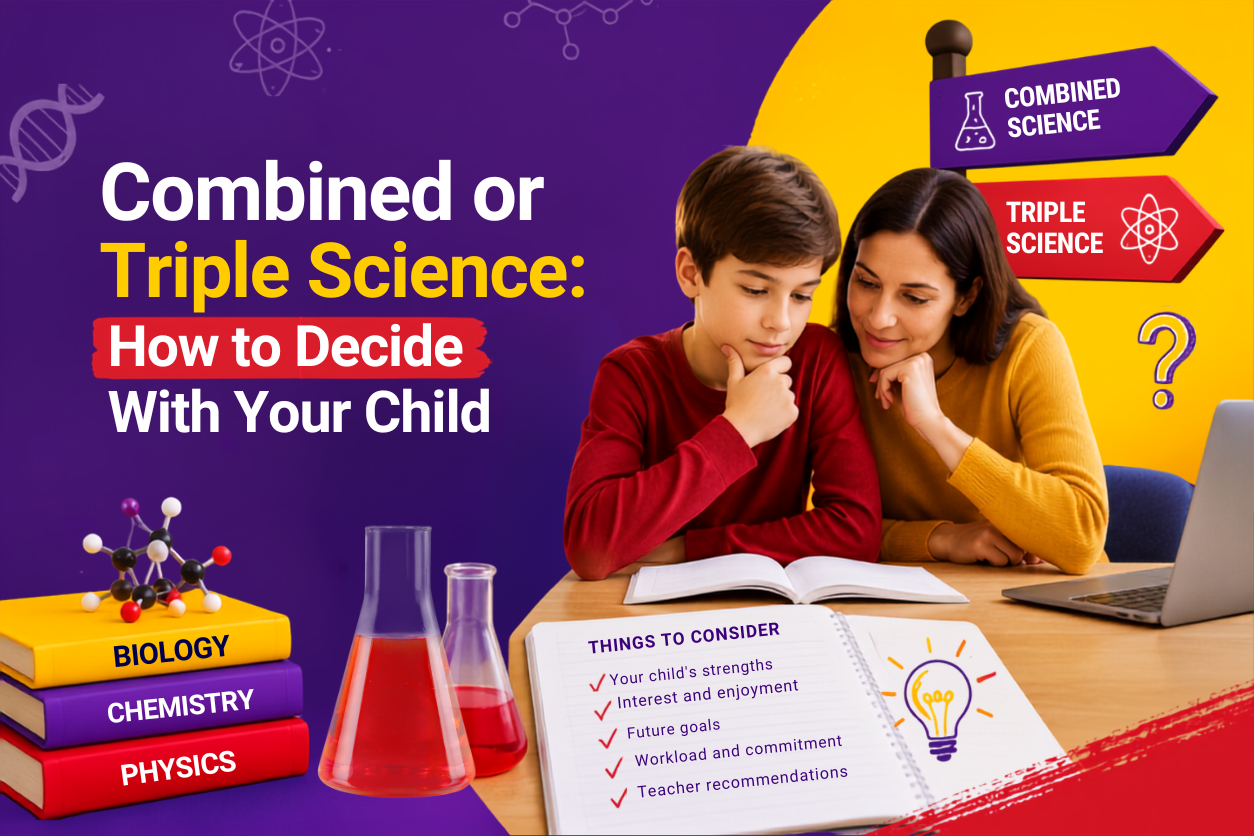
Choosing your GCSE subjects can feel overwhelming, and few decisions cause more confusion than the choice between Combined Science and Triple Science. If you have found yourself asking what is the difference between Combined Science and Triple Science, you are far from alone. Both routes cover biology, chemistry and physics, yet they lead to different qualifications, different workloads and, in some cases, different opportunities. This guide breaks down Combined Science vs Triple Science in plain English, so students and parents can weigh up their GCSE Science options with confidence. By the end, you will know exactly how the two pathways differ and which might suit you best.
Combined Science GCSE, also known as Trilogy, Double Award or Double Science, is the route most students in England take. You still study all three sciences, biology, chemistry and physics, but the course is worth two GCSEs rather than three. Your performance across all three subjects is brought together into two linked grades. These are written as a pair, such as 9-9, 8-7 or 5-5, and they range all the way down to 1-1.
Students sit six exams in total, two in each science, and each paper lasts around one hour and fifteen minutes. Combined Science covers roughly two-thirds of the content found in the Triple Science course, so it is a slightly lighter load. Like Triple Science, it is offered at Foundation tier, aimed at grades 1 to 5, and Higher tier, aimed at grades 4 to 9. One key rule is that you must sit the same tier across every paper, so you cannot, for example, take Higher biology and Foundation physics. It is worth remembering that the two grades carry equal weight to any other GCSE.
Triple Science GCSE, sometimes called Separate Sciences or Single Sciences, is the more in-depth route. Here you study biology, chemistry and physics as three distinct subjects, and you earn three separate GCSEs with three separate grades, one for each science. This is the headline difference: Triple Science gives you an extra GCSE compared with the Combined route.
Interestingly, Triple Science students also sit six exams, two per subject, the same number as Combined Science. The difference is that each paper is longer, at around one hour and forty-five minutes, because there is more to assess. Triple Science covers roughly a third more content, including challenging bridge topics such as space physics, organic chemistry, the brain and the eye, and monoclonal antibodies. These topics smooth the jump to A-Level. Because there is more to learn, Triple Science also takes up more of your timetable each week, and it allows you to mix tiers between subjects.
When you compare Triple Science vs Combined Science GCSE side by side, the contrasts become much clearer. The table below summarises the main differences at a glance.
Feature |
Combined Science |
Triple Science |
|---|---|---|
Number of GCSEs
|
2 GCSEs
|
3 GCSEs
|
Grades awarded
|
Two linked grades (e.g. 8-7)
|
Three separate grades
|
Content covered
|
About two-thirds of Triple
|
Full content, roughly 33% more
|
Number of exams
|
6 (two per science)
|
6 (two per science)
|
Exam length
|
About 1 hour 15 minutes each
|
About 1 hour 45 minutes each
|
Tiers
|
Same tier across all papers
|
Can mix tiers between subjects
|
Time on timetable
|
Less weekly science time
|
More weekly science time
|
In short, both courses involve all three sciences and the same number of exams, but Triple Science goes deeper, takes longer and rewards you with an additional GCSE. Combined Science is more streamlined and frees up time for other subjects.
Whichever route you take, your school chooses the exam board rather than you. The three main boards in England are AQA, Edexcel and OCR, and OCR offers two named variants, Gateway Science and Twenty First Century Science. You will not be asked to pick between them yourself.
The good news is that the core content and the grades are broadly the same across boards, whether you take Combined Science or Triple Science. The differences tend to lie in the style of questions and the way topics are arranged, rather than in difficulty or value. Once you know which board your school uses, you can find past papers and revision resources tailored to that specification, which makes preparation far more efficient.
This is where the biggest myth appears. Many students believe you must take Triple Science to study science at A-Level. That is not true. Most sixth forms and colleges accept a grade 6-6 in Combined Science, or a grade 6 in the relevant Triple Science subject, as the entry requirement for A-Level biology, chemistry or physics. Choosing Combined Science does not close the door on a science career.
That said, Triple Science does offer an advantage. Because it covers those extra bridge topics, it acts as a smoother stepping stone into A-Level, and the additional GCSE can strengthen competitive university and apprenticeship applications. The important caveat is balance. Two strong grade 7s in Combined Science are worth far more than three shaky grade 4s in Triple Science gained while feeling overwhelmed. Both GCSE Science pathways can lead onward; what matters most is the grades you actually achieve.
It is also worth noting that if you are aiming for A-Level science, you will usually need to sit the Higher tier papers on either route, since the top grades that colleges look for are only available at that level. If you are unsure, ask your teachers which tier they expect to enter you for, as this can be just as important as the Combined or Triple decision itself.
So, should you choose Triple Science or Combined Science? There is no single right answer, but a few simple questions can guide the decision. Think honestly about how much you enjoy science, how you are coping with maths and English, and what you might want to do after your GCSEs.
Remember that some schools make the decision for you, or set you on a pathway based on your Year 9 results. If you are unsure, talk it through with your science teachers, who can advise based on your current performance and potential.
Triple Science is not necessarily harder, but it does cover roughly a third more content and includes extra bridge topics. The exams are also longer. Many able students find the depth rewarding, while others prefer the more focused Combined Science workload. It depends on your strengths and how you manage your other subjects.
Combined Science is worth two GCSEs. You still study biology, chemistry and physics, but your performance is reported as two linked grades, such as 8-7. Triple Science, by contrast, is worth three separate GCSEs, one for each science.
Yes. Most sixth forms and colleges accept a grade 6-6 in Combined Science for entry to A-Level biology, chemistry or physics. You will usually need to have taken the Higher tier papers. Triple Science can make the transition smoother, but it is not a requirement.
Often yes, especially earlier in the course, as the two share a large amount of common content. Switching from Combined to Triple can be harder because of the extra topics to catch up on. Always speak to your science department before making any change.
The difference between Combined Science and Triple Science comes down to depth, workload and the number of GCSEs you earn. Triple Science offers more content and an extra qualification, while Combined Science keeps your options open and your timetable lighter. Both are respected routes, and both can lead to A-Level science and beyond. The right choice is the one that matches your interests, your strengths and your wider GCSE plans.
Still weighing up your GCSE Science options? Speak to your science teacher about your Year 9 results, and if you would like tailored guidance, book a free consultation with our tutors to find the pathway that fits you best.

GCSE Sciences can assist you in advancing your academic knowledge and increasing your understanding of core concepts through our practical approach based courses.
Subcribe to notifications to get news
2026 © Copyrights Gscesciences All Right Recived
Know a friend who’s tackling GCSE or A-level Biology, Chemistry or Physics? Refer them to GCSE Sciences and you’ll both get *£10 off* of tuition once they join.
WhatsApp us