Home / Blog
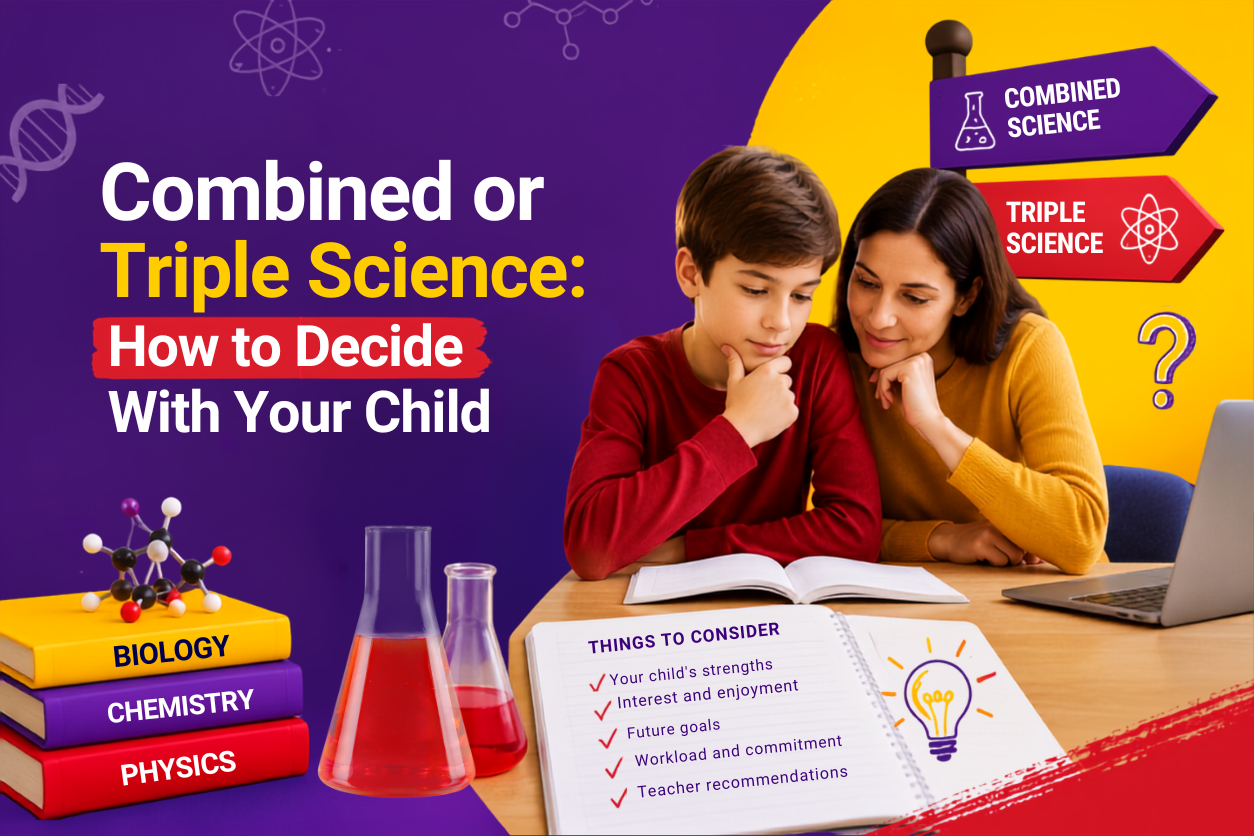
Combined or Triple Science? In short: Triple Science suits confident, science-focused students likely to continue with science A Levels, since it covers more content across three separate GCSEs. Combined Science suits students who enjoy science but want a lighter workload, still gaining a solid, well-rounded science qualification without the extra depth.
Choosing GCSE options can feel like the first “real” academic decision your child makes, and the Combined or Triple Science question is usually one of the biggest parts of it. Get the right fit, and science stays manageable and even enjoyable. Get a poor fit, and it can quietly become the subject dragging down confidence in Years 10 and 11.
This guide walks through exactly what each GCSE Science pathway involves, compares them side by side, and gives you practical ways to help your child choose with confidence, rather than guesswork.
GCSE Combined Science blends Biology, Chemistry, and Physics into a single course, examined together. Most exam boards call this a “double award,” because it results in two GCSE grades rather than three, even though all three subjects are studied.
Students still sit multiple exam papers and cover the core ideas in each subject. The difference is depth: Combined Science covers a smaller set of topics per subject than Triple Science, chosen to give a solid general foundation without requiring students to specialise.
GCSE Triple Science, sometimes called “Separate Sciences,” treats Biology, Chemistry, and Physics as three independent GCSEs. Each subject is examined separately, and each results in its own grade.
Because there are three full GCSEs to cover, Triple Science includes additional content not taught in Combined Science, such as more advanced organic chemistry, particle physics, and further detail on genetics and inheritance. Students following this pathway usually have more timetabled science lessons each week to accommodate the extra material.
The clearest way to see the difference between Combined and Triple Science is to compare them directly across the areas that matter most to families.
Aspect |
Combined Science |
Triple Science |
|---|---|---|
Number of GCSEs awarded
|
2 GCSEs (double award)
|
3 separate GCSEs
|
Subjects studied
|
Biology, Chemistry, and Physics, blended into one course
|
Biology, Chemistry, and Physics, each taught and examined separately
|
Lesson time
|
Standard science timetable allocation
|
Usually extra lessons per week to cover the additional content
|
Difficulty level
|
Covers a smaller set of topics in each subject
|
Covers more content per subject, including topics not in Combined Science
|
Workload
|
Fewer exam papers and a smaller overall revision load
|
Six exam papers in total, plus a larger volume of content to revise
|
Suitable students
|
Students who enjoy science without wanting to specialise further
|
Confident, well-organised students likely to continue with science
|
Progression to A Levels
|
Can lead to science A Levels at some schools, though this varies
|
Generally the more straightforward, widely accepted route into science A Levels
|
Some students show clear signs that Triple Science GCSE will suit them well:
Combined Science can be the stronger option when a student:
Neither pathway is objectively “better.” The right choice depends on the individual student, not a general rule.
Triple Science is not necessarily harder in terms of difficulty per topic, but it does involve more content overall, since it covers additional topics and results in three GCSEs instead of two. Most students who are already coping well with science find the extra content manageable rather than overwhelming, particularly with good time management and, where needed, extra support.
In reality, schools generally set a minimum standard for entry, but plenty of solidly average science students take Triple Science and do well, particularly with the right support in place.
Some students progress from Combined Science to A Level Biology, Chemistry, or Physics successfully, especially with a strong grade and some catch-up support at the start of Year 12. Requirements vary by school and subject, so it’s always worth checking directly.
A lot of exam-day calm is actually built weeks in advance, through familiarity. Students who have practised timed papers repeatedly with a tutor tend to feel less panic on the day simply because the format, pacing, and pressure are no longer unfamiliar. This is one of the most underrated benefits of working with a GCSE Science tutor rather than revising alone: they simulate exam conditions often enough that the real thing feels like just another practice session.
Combined Science still covers substantial content across three subjects and requires genuine understanding, not just less effort.
Whether your child takes Combined Science GCSE or Triple Science GCSE, a good GCSE Science tutor makes the same core difference: identifying exactly where the gaps are and closing them before they compound. This matters more for Triple Science, purely because there is more content to keep on top of, but Combined Science students benefit just as much from focused, exam-board-specific support.
For families considering GCSE Science tuition in Milton Keynes, tuition can be tailored to either pathway, with subject-specific support available through GCSE Biology tuition, GCSE Chemistry tuition, and GCSE Physics tuition for Triple Science students who want to focus on one subject in particular. As your child moves from choosing options into the course itself, resources on Year 10 GCSE Science and, later, Year 11 GCSE revision can help keep momentum going right through to exams.
Choose Triple Science if your child is confident across Biology, Chemistry, and Physics, manages their workload well, and is likely to continue with a science A Level. If any of those don't apply yet, Combined Science may be the more comfortable starting point.
Many medicine, dentistry, and veterinary courses prefer or expect Triple Science, though requirements vary by university, so it's worth checking specific course pages directly rather than assuming.
Combined Science results in two GCSEs from one blended course, while Triple Science results in three separate GCSEs with more content in each subject.
There isn't a single "best" option. The right choice depends on your child's confidence in science, current workload, and future plans, not a general ranking of one pathway over the other.
Switching is sometimes possible early in Year 10, depending on the school's timetable and staffing, but it becomes harder once the courses have properly started, so it's worth raising any doubts as soon as possible.
Three separate science grades can add breadth to a GCSE profile, but universities and employers generally care more about the grades achieved than which pathway produced them.
Combined Science counts as two GCSEs, awarded from one combined course covering Biology, Chemistry, and Physics.
Yes. Triple Science means GCSE Biology, Chemistry, and Physics are taught and examined as three fully separate GCSEs, each with its own grade.
Most schools offer it, but not all, and some set minimum grade requirements for entry. Check with your child's school directly to confirm what's available.
There’s no universally correct answer to Combined or Triple Science. The right pathway is the one that matches your child’s confidence, workload, and future plans, not the one that sounds more impressive on paper. Talk it through honestly, involve your child in the decision, and don’t be afraid to ask their science teacher for a professional view.
Whichever pathway you choose, the right support can make all the difference to how your child experiences GCSE Science. If you’d like a clearer picture of where your child currently stands, book an introductory GCSE Science tuition session and we’ll help you plan the pathway, and the support, that fits them best.
GCSE Sciences can assist you in advancing your academic knowledge and increasing your understanding of core concepts through our practical approach based courses.
Subcribe to notifications to get news
2026 © Copyrights Gscesciences All Right Recived
Know a friend who’s tackling GCSE or A-level Biology, Chemistry or Physics? Refer them to GCSE Sciences and you’ll both get *£10 off* of tuition once they join.
WhatsApp us