Skip to the content
Skip to content
Skip to the content
Skip to content Home / Blog
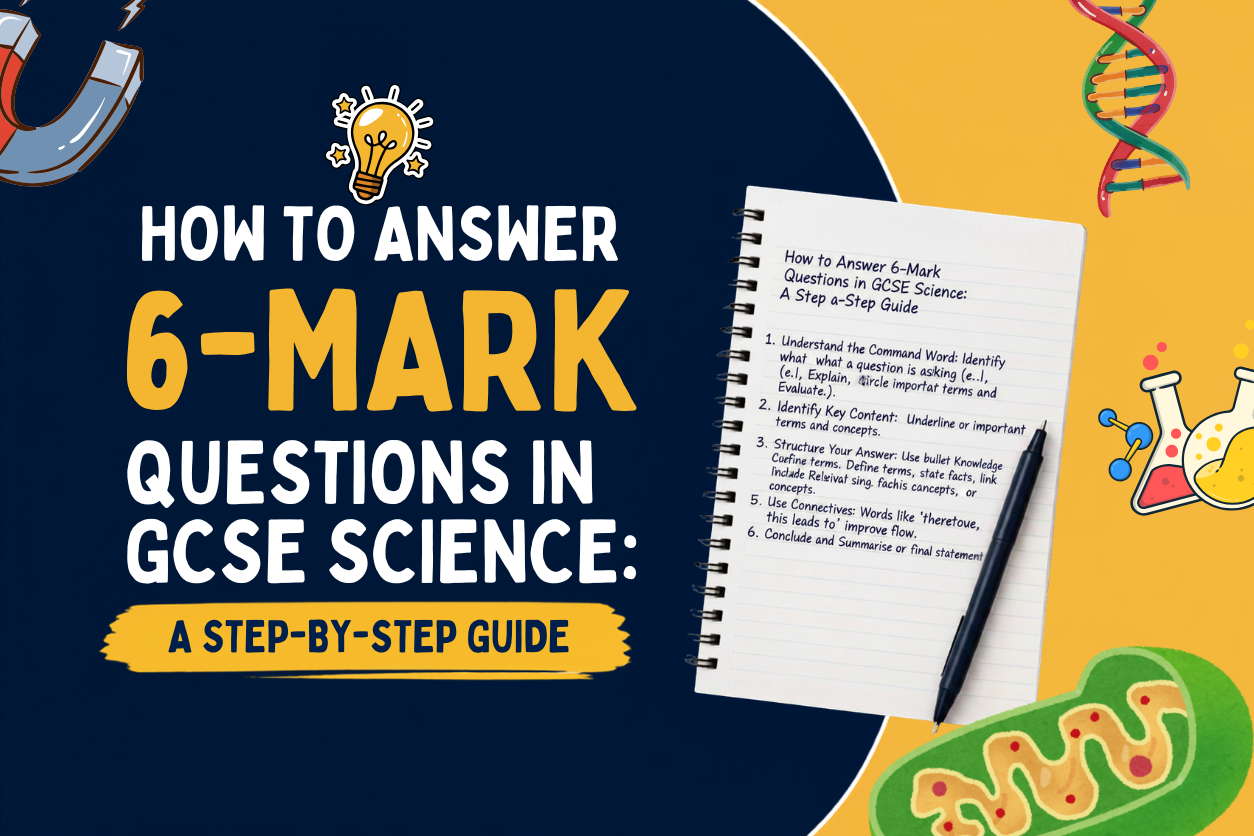
The best way to answer GCSE Science 6 mark questions is to plan 4–6 clear points before writing, use the “state, explain, link” structure for each point, apply precise scientific vocabulary, tie every point back to the question’s context, and finish with a conclusion if the command word is “evaluate” or “compare.” This matches the levels-of-response mark scheme used by AQA, Edexcel, and OCR.
Six-mark questions carry more weight than any other question on a GCSE Science paper, yet many students lose marks simply because they don’t know how the examiner is scoring their answer. This guide breaks down the GCSE Science 6 mark question structure, walks through worked GCSE Science 6 mark question examples, and gives you a repeatable method you can use in every exam.
Get the free 6-Mark Answer Checklist and Practice Pack — including three fully worked examples and a mark-scheme self-check sheet — sent straight to your inbox.
The GCSE Science 6 mark question structure is based on “levels of response” marking, not a simple checklist of facts. Examiners place your answer into one of three bands:
This means two students can know the same facts, but the one who organises their answer clearly will score higher.
The best way to answer GCSE Science 6 mark questions is to follow a consistent six-step method every time, rather than writing everything you know and hoping for the best.
Our free practice pack includes a one-page revision card you can stick on your wall, plus five past-paper style questions with model answers.
Seeing the method applied makes it far easier to reproduce in an exam. Here are two worked GCSE Science 6 mark question examples
This advantages–disadvantages–judgement pattern is exactly what examiners look for in “evaluate” questions.
Aim for 4–6 distinct, well-explained scientific points — roughly one point per mark, though examiners reward depth and linkage over sheer quantity.
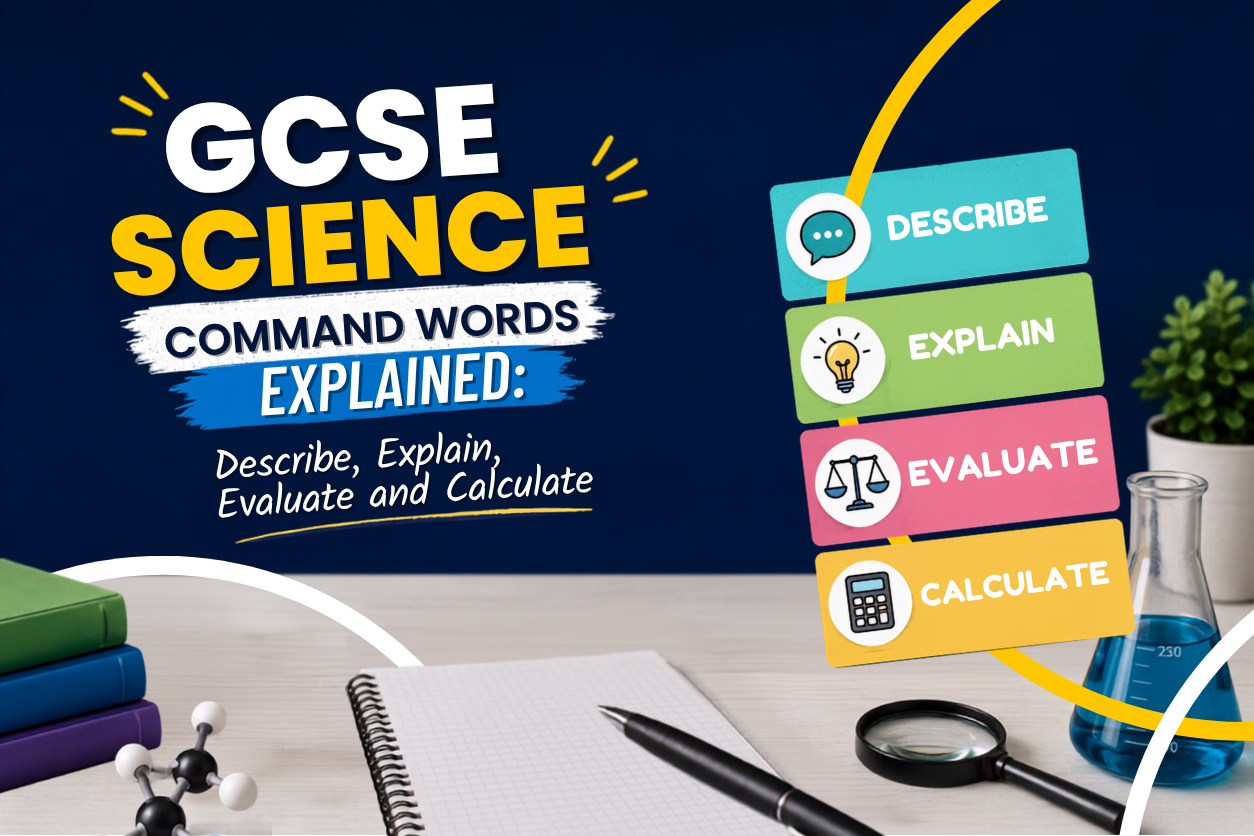
"Explain" asks for reasons and mechanisms behind a fact. "Evaluate" asks you to weigh up advantages and disadvantages and reach a justified conclusion.
Only for command words like "evaluate," "compare," or "assess." "Describe" and "explain" questions don't require a final judgement.
As a guide, spend roughly 1 minute per mark, plus 60–90 seconds for planning — so around 7–8 minutes in total.
Yes — a clear bullet-point plan with 4–6 labelled points can still gain Level 2 marks even if you don't finish full sentences, because examiners can follow your reasoning.
Get the free 6-Mark Answer Checklist and Practice Pack — three worked examples, a one-page revision card, and a self-marking guide — delivered straight to your inbox. No spam, unsubscribe anytime.

GCSE Sciences can assist you in advancing your academic knowledge and increasing your understanding of core concepts through our practical approach based courses.
Subcribe to notifications to get news
2026 © Copyrights Gscesciences All Right Recived
Know a friend who’s tackling GCSE or A-level Biology, Chemistry or Physics? Refer them to GCSE Sciences and you’ll both get *£10 off* of tuition once they join.
WhatsApp us
 Optimized by Seraphinite Accelerator